
The Life Point Allocation Model
A clearer way to think about energy, attention, and uneven progress

The Real Problem With How We Measure Progress
Most people aren’t struggling because they lack discipline.
They’re struggling because they’re using the wrong model.
We tend to evaluate our lives as if everything should improve at the same time.
Career should be moving forward.
Health should feel dialed in.
Relationships should be strong.
Finances should be stable.
Creativity should be alive.
When one area lags, we get uneasy.
When several lag at once, we assume something is wrong with us.
But that expectation doesn’t match reality.
Life is not built for constant, evenly distributed progress. It operates under constraints: finite energy, limited attention, uneven time, and shifting responsibilities. Capacity expands and contracts. Priorities compete. Context changes.
Yet we judge ourselves as if effort alone should override all of it.
That mismatch is where frustration comes from.
Not because you aren’t trying hard enough.
But because you’re expecting consistent output from a variable system.
I think there’s a simpler, more accurate way to think about this.
I call it the Life Point Allocation Model.
The Life Point Allocation Model (In Plain Terms)
At its core, the model treats your energy, attention, and time as a finite set of points that must be allocated across the different areas of your life.
Those areas change over time.
Your total capacity changes day to day.
Progress depends less on motivation and more on how intentionally those points are distributed given real constraints.
This isn’t a motivational framework.
It’s a clarity framework.
By the end of this article, you won’t magically have more energy or more time. But you will have a clearer way to understand:
where your effort is actually going
why some areas feel chronically underfunded
and how to make better tradeoffs without assuming you’re failing
If you’ve ever felt behind despite putting in effort, this model is meant to give you something better than encouragement.
It’s meant to give you a clearer lens.
Life Points and Finite Capacity
The model starts with a baseline.
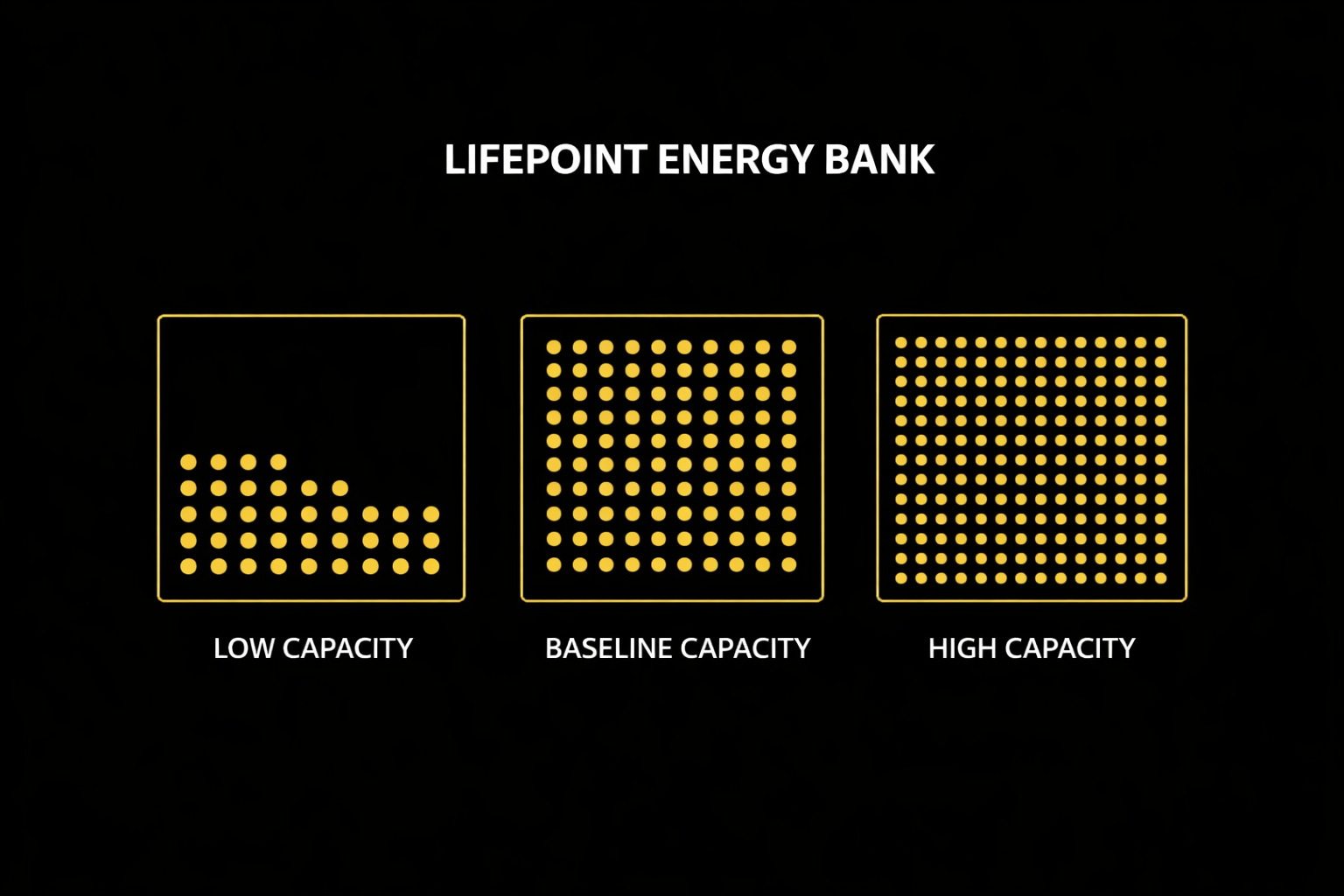
Assume you have 100 Life Points.
This number isn’t scientific. It’s a reference point — a way to think clearly without overcomplicating things. Those 100 points represent your usable energy, attention, and time on a normal day. Not your best day. Not your worst.
Everything you do draws from that pool.
Some days you wake up with close to your full 100.
Other days you’re operating at 80.
Sometimes 60.
Occasionally, you spike above baseline — 110 or 120 — fueled by excitement, novelty, momentum, or adrenaline.
That fluctuation is normal.
What’s not normal is pretending every day is a 100-point day.
Most people hold themselves to their baseline even when their capacity has dropped. They try to allocate points they don’t actually have. When things start slipping, they interpret it as a motivation problem instead of a capacity problem.
But capacity isn’t fixed.
It responds to sleep, stress, health, emotional load, external responsibilities, and the season of life you’re in. Some of that is in your control. Much of it isn’t.
The model doesn’t judge that.
It simply accounts for it.
A low-capacity day isn’t a failure state.
It’s a different rule set.
What You’re Actually Allocating Toward
Once you accept that your Life Points are finite, the next question becomes unavoidable:
What are you allocating them toward?
This is the part most people skip. Not because it’s difficult, but because it’s uncomfortable.
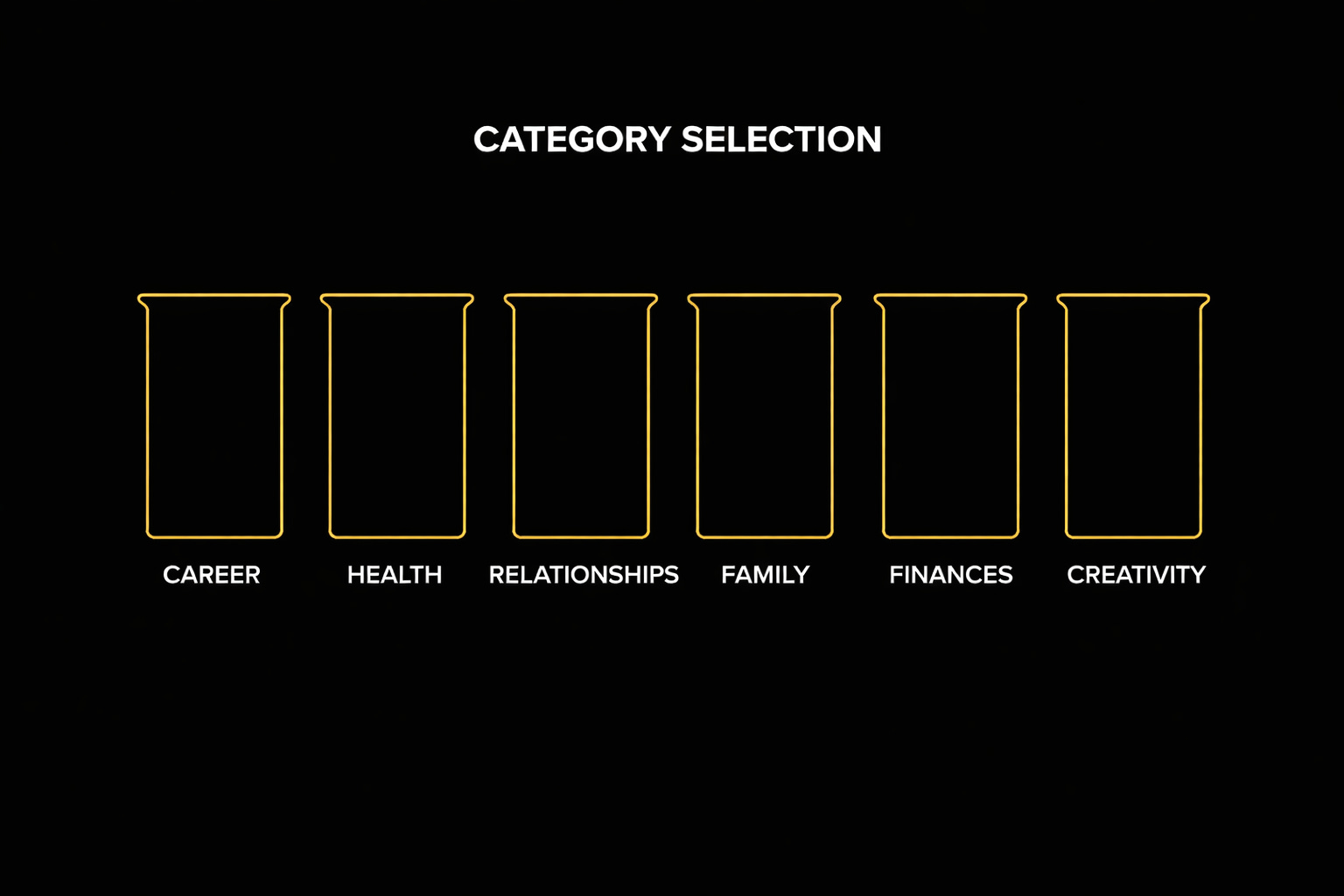
We tend to assume the categories of our lives are fixed:
Career
Health
Relationships
Family
Money
Creativity
But categories aren’t permanent. They’re contextual.
Rather than treating them as fixed, it’s more accurate to think of them as active areas of focus. You’re choosing which parts of your life are asking for attention right now, and which ones can stay in the background.
Every category you include is something that can receive Life Points.
Every category you exclude is something you’re choosing not to prioritize — at least for now.
There’s no hard limit on how many categories you can have.
But there is a consequence.
The more categories you include, the thinner your Life Points get spread.
That tradeoff is where most quiet frustration comes from.
Not because you’re doing the wrong things.
But because you’re trying to fund too many things with the same 100 points.
Some common categories people allocate toward at different stages of life:
Career or work
Health and fitness
Relationships or dating
Family
Financial stability
Learning or skill-building
Creativity or side projects
Rest and recovery
Community or social life
You don’t need all of these active at once.
And they will change over time.
What matters isn’t picking the “right” categories.
It’s noticing which ones actually deserve a seat at the table in this season of your life.
If you don’t choose intentionally, the categories still exist.
They just claim Life Points by default.
Allocation Is Dynamic, Not Fixed
Once you define your categories, allocation becomes a practical problem.
But it’s important to be clear about one thing:
Allocation is not static.
Your capacity changes.
Your priorities shift.
Your responsibilities evolve.
That’s not inconsistency.
That’s adaptation.
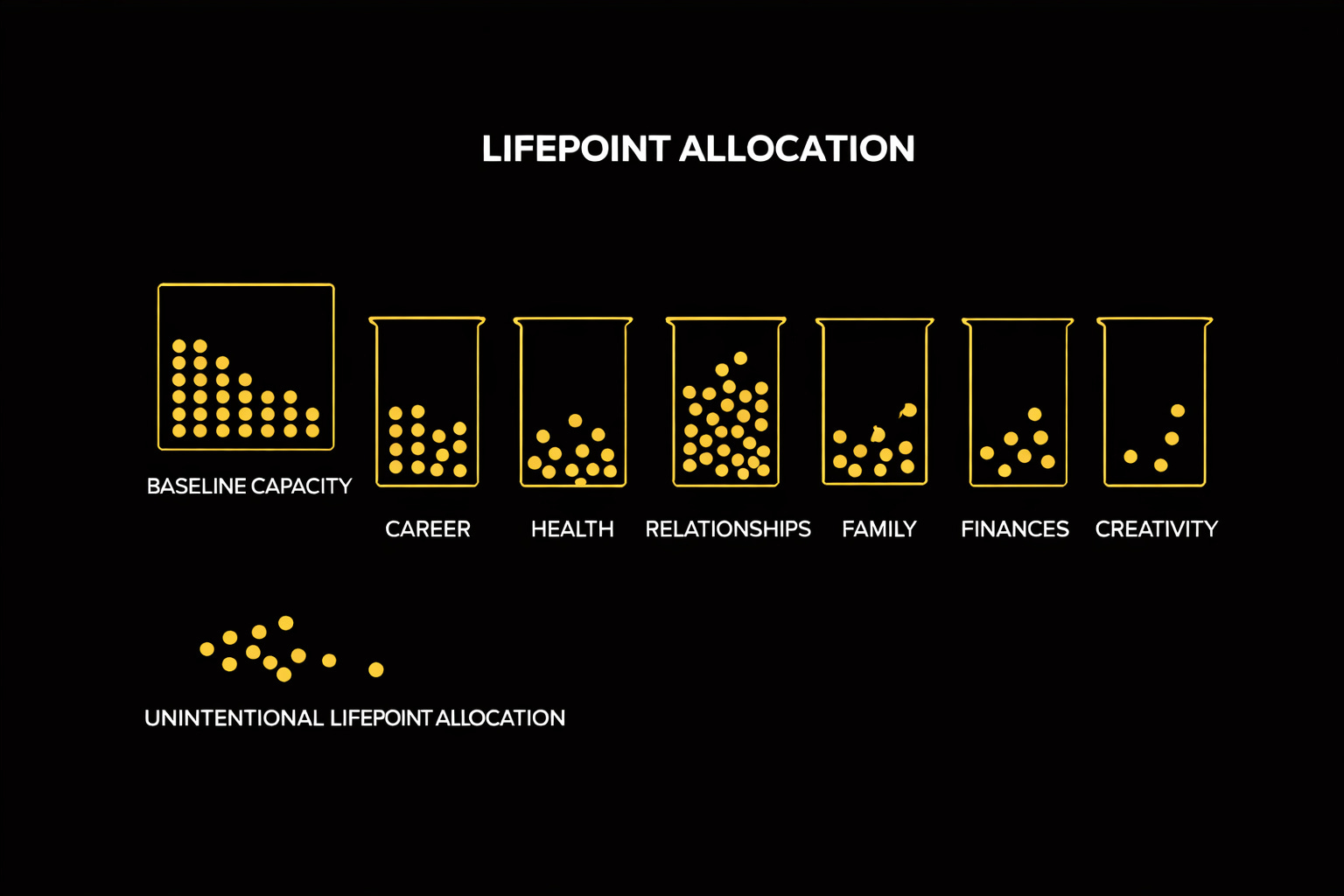
The Life Point Allocation Model isn’t meant to produce a single, perfect distribution. It’s meant to give you a rough map of where your energy is going right now, so you can notice misalignment and adjust when needed.
Some Life Points are also spent unintentionally.
Passive scrolling.
Low-grade digital noise.
Default commitments.
Mental overhead that doesn’t clearly support rest, growth, or recovery.
These aren’t moral failures.
But they are allocations.
When they aren’t acknowledged, they behave like hidden categories — quietly reducing the points available to everything else.
The goal isn’t precision.
It’s awareness.
Capacity Shifts Change the Strategy
This is where most people get stuck.
They keep the same strategy regardless of capacity.
On a 60-point day, they try to play a 100-point game. When that doesn’t work, they blame themselves.
But low-capacity days require a different approach.
On those days, balance is often the wrong goal. Concentration matters more. Protecting one or two critical categories is usually the correct move. Everything else runs at minimum, or not at all.
Sometimes the most rational allocation is:
one meaningful task
basic maintenance
and stopping early
That isn’t giving up.
It’s preserving the system.
High-capacity days have their own trap. They feel good, so we try to make them permanent. But spikes are temporary by nature. They’re opportunities, not new baselines.
The model treats capacity shifts as rule changes, not character flaws.
A 60-point day played well is not worse than a 100-point day played poorly.
It’s often better.
The End-of-Day Life Point Reflection
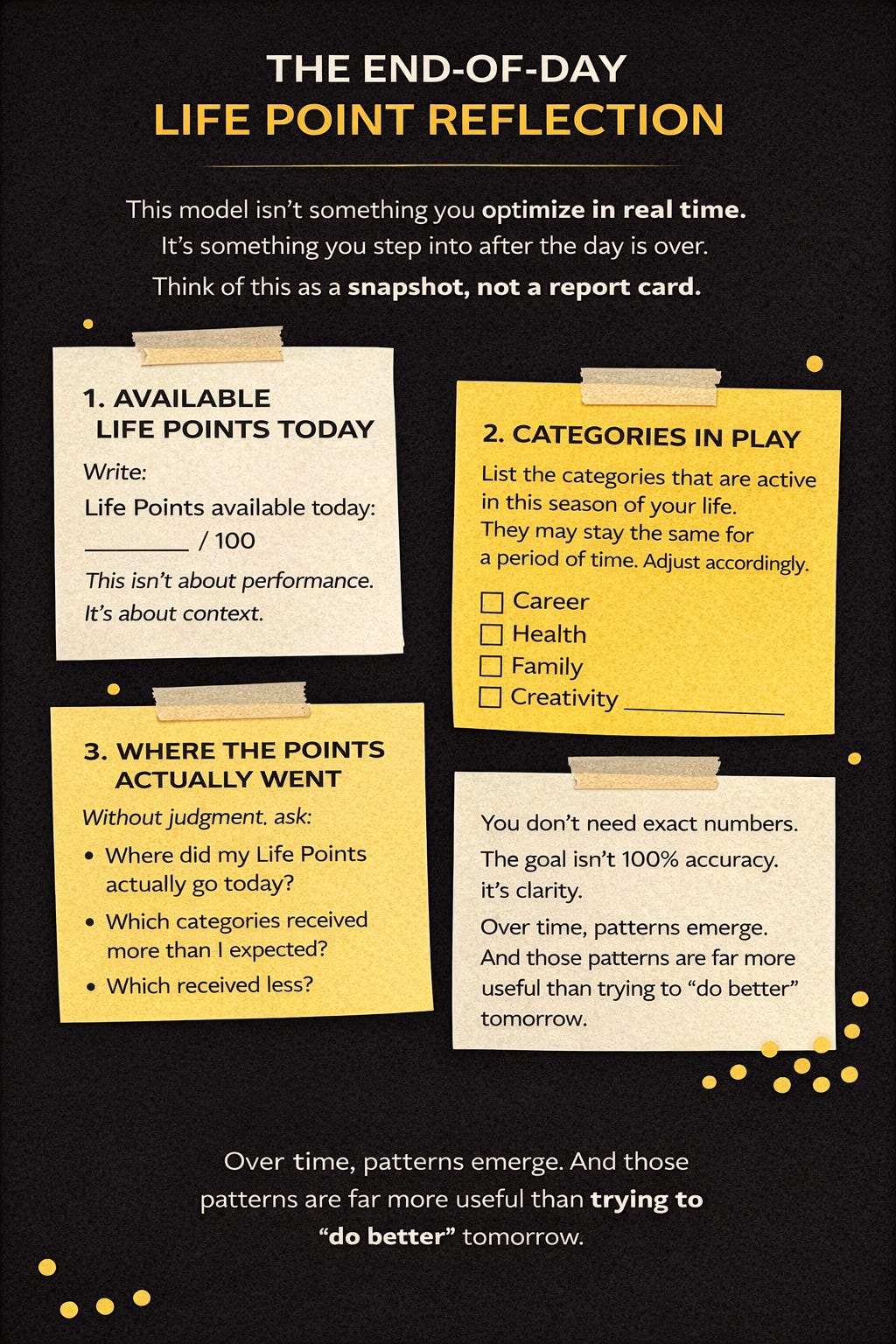
This model isn’t something you optimize in real time.
It’s something you step into after the day is over.
Think of this as a snapshot, not a report card.
1. Available Life Points Today
Write:
Life Points available today: ___ / 100
This isn’t about performance. It’s about context.
2. Categories in Play
List the categories that are active in this season of your life. They may stay the same for a period of time. Adjust accordingly.
3. Where the Points Actually Went
Without judgment, ask:
Where did my Life Points actually go today?
Which categories received more than I expected?
Which received less?
Did any points drift into non-value-added areas?
Does this feel aligned with what matters right now?
You don’t need exact numbers.
The goal isn’t 100% accuracy. It’s clarity.
Over time, patterns emerge. And those patterns are far more useful than trying to “do better” tomorrow
A Better Lens
Uneven progress isn’t a personal failure.
It’s the natural result of living within constraints.
You don’t need to improve every area of your life at once.
You don’t need a perfect allocation.
You don’t need to turn this into something you manage obsessively.
What helps is clarity.
Clarity about how much capacity you actually have.
Clarity about what matters in this season of your life.
Clarity about where your Life Points are really going.
Once that’s clear, a lot of pressure disappears.
Low-capacity days stop feeling like weakness.
Imbalance stops feeling like failure.
Progress starts making sense again.
The Life Point Allocation Model isn’t a rulebook.
It’s a lens.
Not to optimize your life —
just to understand it better.
And sometimes, that’s enough.

Thanks
Thanks