

The Most Valuable Asset You're Probably Ignoring
It is not your money, your house, your resume, or your network.

Most people think about capital in financial terms.
Money. Investments. Assets. Net worth.
But there is another kind of capital that may matter even more, especially when you are still trying to figure shit out:
identity capital.
The phrase sounds more academic than it needs to. To me, it is simply the collection of things you build inside yourself over time. Your abilities. Your skills. Your stories. Your experiences. Your traits.
The things that do not always show up on a balance sheet, a resume, or a scoreboard, but quietly shape what opportunities you can recognize, what rooms you can walk into, and what kind of person you are becoming.
And unlike most things people chase in their twenties, this is something no one can take from you.
My journey with writing has been the clearest example of this in my own life.
When I first bought a journal in July of 2023, I was not trying to build a platform, become “a writer,” or create some grand personal development system.
I was just 23, freshly out of college, living in a small studio apartment, and trying to figure out what adulthood was supposed to look like.
So I started writing. I decided that I would commit to roughly ten minutes a day.
For a while, it looked like nothing.
But looking back, those pages were quietly building something in me. They helped me think more clearly, notice patterns, articulate ideas, and eventually gave me enough confidence to start writing publicly on Substack.
More on that journey here:

The funny part is that the notebook was never just producing pages.
It was producing assets.
Miyamoto Musashi understood this long before anyone called it identity capital.
Most people remember him as one of the greatest swordsmen in history, but that is only part of the story. Musashi was also a writer, painter, calligrapher, strategist, and philosopher.
His mastery was not limited to one lane.
The sword sharpened his discipline. Painting sharpened his observation. Writing sharpened his philosophy. Strategy sharpened how he understood conflict, timing, and human nature.
I write about this idea more in depth here:

Each pursuit added something to the person he was becoming.
That is what made him dangerous, not just as a fighter, but as a thinker.
He was not simply collecting skills. He was becoming more complete.

See, the goal is not to collect random skills just for the sake of looking more impressive. The goal is to build a deeper personal asset base you can carry into any room, role, project, and season of life you may find yourself in.
Because identity capital is not one thing.
It is not just your talent. It is not just experience. It is not just confidence. It is a combination of everything you have practiced, survived, learned, and noticed.
Because the idea can feel abstract, I find it helpful to break identity capital down into something more tangible.
That is why I like thinking of it as an A.S.S.E.T.
A — Actions | What you repeatedly do.
Journaling. Going to the gym. Calling your parents. Reading before bed. Publishing an article every week.
S — Skills | The competencies those repetitions develop.
Writing. Public speaking. Photography. Financial planning. Coding. Sales.
S — Stories | The narratives you carry about yourself and the lessons you’ve earned.
The story of moving abroad. The story of paying off debt. The story of starting from zero. The story of overcoming failure. The story that you are resilient. The story that you are capable of more than you thought.
E — Exposure | The people, places, ideas, and environments that expand your perspective.
Traveling to a new country. Reading books outside your worldview. Meeting mentors. Taking a job outside your comfort zone. Attending conferences. Having difficult conversations.
T — Traits | The natural wiring you discover, sharpen, and turn into an advantage.
Curiosity. Discipline. Creativity. Empathy. Pattern recognition. Adaptability. The things that feel natural to you, but become valuable when you notice them, practice them, and learn where they are useful.
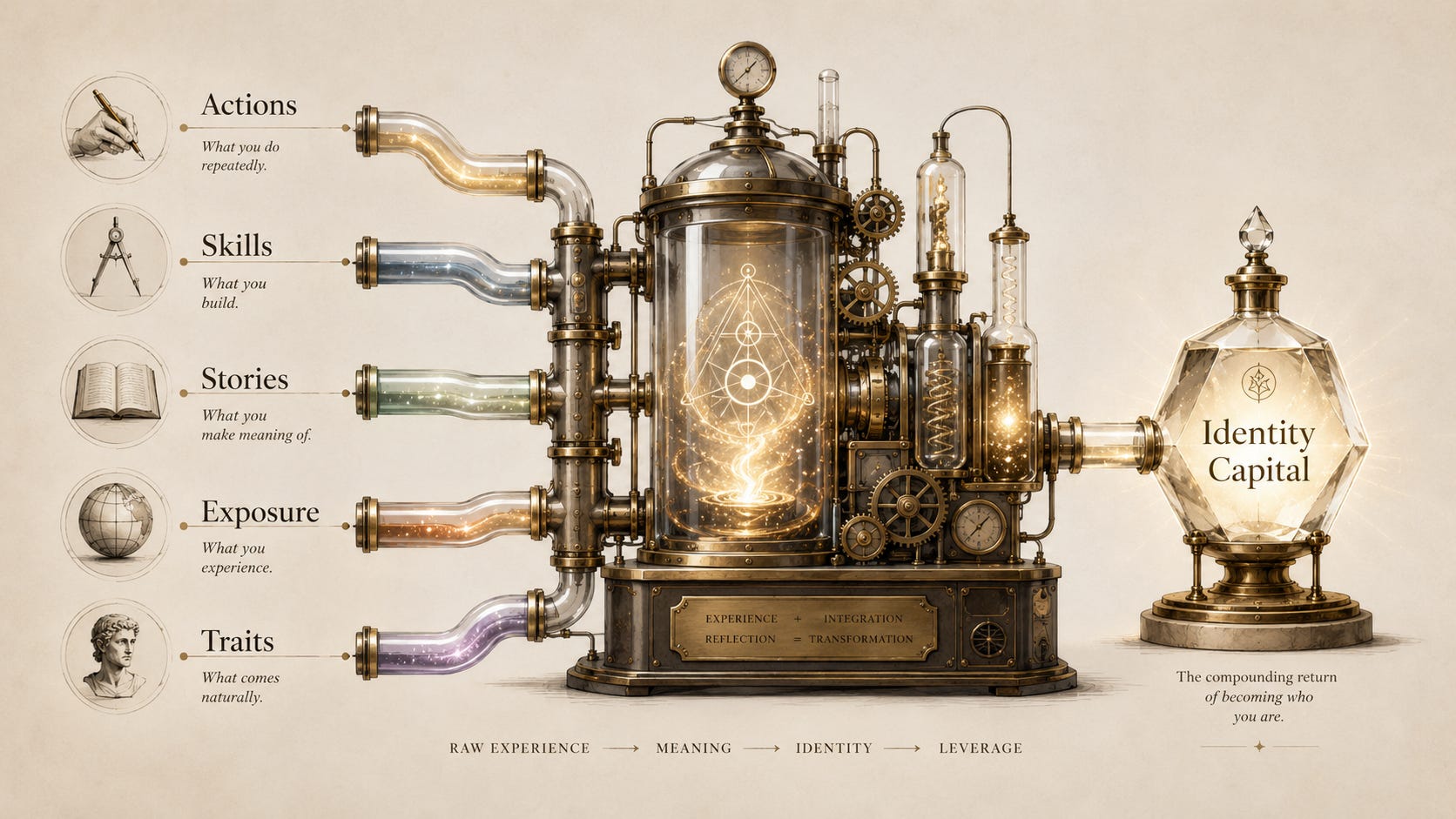
That is the real value of identity capital.
You may not always know where the action, skill, story, exposure, or trait will lead. I certainly did not know a ten-minute journaling habit would eventually become hundreds of pages, a public writing practice, and a clearer sense of who I was becoming.
But that is how these things work.
You build the asset before you fully understand its value.
And maybe that is the question worth asking more often:
Not, “Will this pay off immediately?”
But, “What is this building in me?”
Love it. I see so many young people not building skills. The thing is when you build skills you become more confident and helpful!