
5 Reasons Why You Should Read More Books
Plus the 100 books I’d recommend

I’m moving this week, which means everything I own is scattered across the floor and I’m being forced to confront how much stuff I’ve accumulated.
One of those things was books.
As I laid them out together, I realized I wasn’t just looking at a pile of books. I was looking at a record of the last few years of my life.
Books are fascinating because their value is deeply personal. Sometimes you read one at the right time, take one idea from it, and only realize years later how much it shaped the way you think.
Somewhere around four years ago, I started taking my life more seriously. Not perfectly. Not all at once. But I started asking better questions about money, discipline, anxiety, ambition, career, health, purpose, relationships, and the kind of person I wanted to become.
Again and again, books became one of the places I went looking for answers.
I don’t think books magically changed my life. But they changed how I interpreted my life. They gave me language, perspective, comfort, and direction when I needed it.
So as I looked at that pile on the floor, I kept coming back to one thought:
Reading in your early 20s might be one of the highest-return things you can do for yourself.
And honestly, I don’t think you should ever stop.
Here are five reasons why…
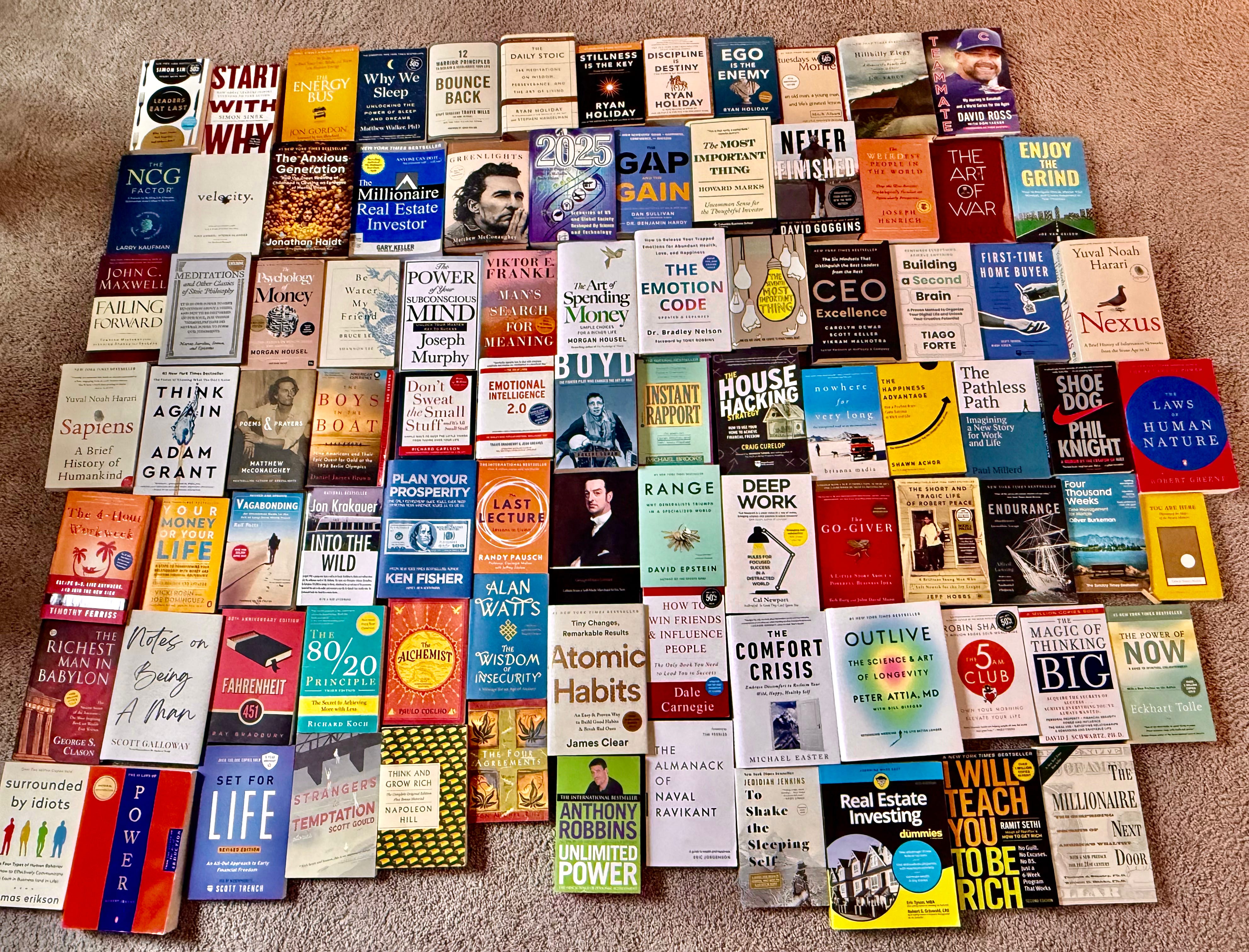
Before we get into it, I included a full list at the end of this piece with 100+ books I’ve read over the last few years, organized by category.
And if you enjoy this type of content, consider subscribing to Present & Progressing, where I share reflections on personal growth, mindset, and navigating life with more intention from the perspective of someone in their 20s.
1. Books give you mentors you may never meet.
You may not have access to the smartest, wealthiest, or most experienced people in real life. Geography, money, age, job title, and social circles all create limits.
Books remove many of them.
René Descartes wrote that reading good books is like having a conversation with the finest minds of past centuries.
I like that framing because a good book can feel like a one-way mentorship. You may never sit across from Marcus Aurelius, Naval Ravikant, Morgan Housel, Phil Knight, or Ben Horowitz, but you can still spend hours with their best thinking.
For the cost of a book, you can borrow lessons that took someone else decades to learn.
Books from my list that reinforced this idea:
Meditations, The Almanack of Naval Ravikant, The Psychology of Money, Shoe Dog, The Hard Thing About Hard Things, How to Win Friends & Influence People, The Art of War, The Most Important Thing
2. Books expand your perspective.
It is very easy to mistake your worldview for the world view.
Books remind you that your experience is only one version of reality. They let you step inside someone else’s mind, culture, pain, ambition, imagination, or way of seeing the world.
Neil Gaiman once described books as “little empathy machines,” which feels like the perfect phrase. A good book can make your world feel bigger without requiring you to leave your room.
You begin to understand people you may never meet, places you may never go, and problems you may never personally experience.
Books from my list that reinforced this idea:
Man’s Search for Meaning, The Short and Tragic Life of Robert Peace, Hillbilly Elegy, Into the Wild, Nowhere for Very Long, To Shake the Sleeping Self, Vagabonding, The Boys in the Boat, The Weirdest People in the World, Nexus
3. Books remind you that your problems are not uniquely yours.
Your early 20s can feel very isolating.
You can convince yourself that you are the only person who feels behind, anxious, confused, restless, insecure, ambitious, or unsure of what to do next.
Books have a way of proving otherwise.
C.S. Lewis wrote about reading as a way to become “more than ourselves,” to see with other eyes and feel with other hearts. That is one of the most comforting parts of reading. It reminds you that people have wrestled with fear, grief, purpose, uncertainty, love, ambition, and meaning long before you arrived.
A good book may not solve your problems, but it can give you language for them. And sometimes, language is the first form of relief.
Books from my list that reinforced this idea:
The Defining Decade, The Body Keeps the Score, Living a Non-Anxious Life, The Wisdom of Insecurity, The Untethered Soul, The Power of Now, 10% Happier, Tuesdays With Morrie, The Last Lecture, Don’t Sweat the Small Stuff
4. Books expand your sense of what is possible.
Books have a way of loosening the grip of the default path.
They show you different ways to work, build wealth, travel, think, create, live, and define success. Sometimes all it takes is seeing one person live differently to realize you have more options than you thought.
Paul Millerd calls this The Pathless Path, which is a fitting phrase for the kind of life that becomes possible when you stop assuming there is only one correct route.
A good book can make your future feel less fixed.
Books from my list that reinforced this idea:
The Pathless Path, The 4-Hour Workweek, Die With Zero, The 5 Types of Wealth, The Millionaire Fastlane, I Will Teach You to Be Rich, The Simple Path to Wealth, Your Money or Your Life, Set for Life, The Comfort Crisis, Four Thousand Weeks
5. Books make you better in conversation and connection.
Being well-read is not about sounding smart.
It is about becoming more useful, curious, and connected. Books give you better questions, better references, and better recommendations to offer other people.
Neil Pasricha’s 3 Books podcast is built around a simple question: what are the three most formative books in someone’s life? I like that because books naturally create deeper conversations. They reveal what people value, what they are wrestling with, and what has shaped how they see the world.
A good book recommendation can be a gift. And the more you read, the more you can give.
Books from my list that reinforced this idea:
How to Win Friends & Influence People, The Go-Giver, Think Again, Start With Why, Leaders Eat Last, Emotional Intelligence 2.0, Instant Rapport, Set Boundaries, Find Peace, Same As Ever, The 5 Types of Wealth
Reading is not a phase.
The reason I say you should read in your early 20s, and forever, is because reading is not something you graduate from.
The more you learn, the more you realize how much you do not know.
There is a quote often attributed to Harry S. Truman that says,
“The only thing new in the world is the history you do not know.”
I think about that often.
So many of the problems we believe are new are just old questions wearing modern clothes. Money. Power. Anxiety. Ambition. Love. Discipline. Meaning. Fear. Human nature does not change as much as we think it does.
Books remind you of that.
They keep you humble. They keep you curious. They keep you from becoming too impressed with your own perspective.
And maybe that is the real value of reading. Not that you eventually arrive at all the answers, but that you get better at asking the questions.
As promised, below is a categorized list of 100+ books I’ve read over the last few years.
This is not a list of books everyone needs to read. Some I loved. Some I probably outgrew. Some gave me one idea and that was enough.
But looking at them together, I can see the questions I was asking in different seasons of my life.
Questions about money, discipline, anxiety, ambition, career, health, purpose, relationships, and what kind of person I wanted to become.
Hopefully, one of them helps you find the next question worth asking. Enjoy!
Personal Growth, Mindset & Self-Improvement
Atomic Habits — James Clear
As a Man Thinketh — James Allen
The Magic of Thinking Big — David Schwartz
The Subtle Art of Not Giving a F*ck — Mark Manson
Everything Is F*cked — Mark Manson
Don’t Sweat the Small Stuff — Richard Carlson
The Four Agreements — Don Miguel Ruiz
The Three Questions — Don Miguel Ruiz
The Gap and the Gain — Dan Sullivan & Dr. Benjamin Hardy
Feel-Good Productivity — Ali Abdaal
The 5AM Club — Robin Sharma
The 80/20 Principle — Richard Koch
Unlimited Power — Tony Robbins
The Power of Your Subconscious Mind — Joseph Murphy
Failing Forward — John C. Maxwell
The Energy Bus — Jon Gordon
GRIT — Angela Duckworth
The Happiness Advantage — Shawn Achor
Philosophy, Stoicism & Inner Life
Meditations — Marcus Aurelius
The Daily Stoic — Ryan Holiday & Stephen Hanselman
The Obstacle Is the Way — Ryan Holiday
Ego Is the Enemy — Ryan Holiday
Stillness Is the Key — Ryan Holiday
Discipline Is Destiny — Ryan Holiday
Right Thing, Right Now — Ryan Holiday
The Power of Now — Eckhart Tolle
The Untethered Soul — Michael A. Singer
The Surrender Experiment — Michael A. Singer
The Wisdom of Insecurity — Alan Watts
You Are Here — Thich Nhat Hanh
The Alchemist — Paulo Coelho
Man’s Search for Meaning — Viktor Frankl
Ikigai — Héctor García & Francesc Miralles
Money, Personal Finance & Investing
The Psychology of Money — Morgan Housel
Same As Ever — Morgan Housel
The Art of Spending Money — Morgan Housel
I Will Teach You to Be Rich — Ramit Sethi
The Simple Path to Wealth — JL Collins
Your Money or Your Life — Vicki Robin & Joe Dominguez
The Millionaire Next Door — Thomas J. Stanley & William D. Danko
The Richest Man in Babylon — George S. Clason
The Millionaire Fastlane — MJ DeMarco
The 5 Types of Wealth — Sahil Bloom
Broke Millennial — Erin Lowry
Breaking Free From Broke — George Kamel
FIRE for Dummies — Michael J. Withey
Plan Your Prosperity — Ken Fisher
The Most Important Thing — Howard Marks
Think & Grow Rich — Napoleon Hill
Wealth Your Way — Wealth Your Way Insights
Real Estate, Housing & Financial Independence
Set for Life — Scott Trench
The House Hacking Strategy — Craig Curelop
First-Time Home Buyer: The Complete Playbook — Scott Trench & Mindy Jensen
Real Estate Investing for Dummies — Eric Tyson & Robert S. Griswold
The Millionaire Real Estate Investor — Gary Keller
Stop Working & Start Investing — Logan Allec
Career, Business, Leadership & Work
Deep Work — Cal Newport
Building a Second Brain — Tiago Forte
Good to Great — Jim Collins
Start With Why — Simon Sinek
Leaders Eat Last — Simon Sinek
CEO Excellence — Carolyn Dewar, Scott Keller & Vikram Malhotra
The Hard Thing About Hard Things — Ben Horowitz
Shoe Dog — Phil Knight
The Go-Giver — Bob Burg & John David Mann
The Almanack of Naval Ravikant — Eric Jorgenson
The 4-Hour Workweek — Tim Ferriss
The Pathless Path — Paul Millerd
The NCG Factor — Larry Kaufman
Velocity — Ajaz Ahmed & Stefan Olander
The Art of War — Sun Tzu
The 48 Laws of Power — Robert Greene
Relationships, Communication & Social Intelligence
How to Win Friends & Influence People — Dale Carnegie
Emotional Intelligence 2.0 — Travis Bradberry & Jean Greaves
Instant Rapport — Michael Brooks
Set Boundaries, Find Peace — Nedra Glover Tawwab
Surrounded by Idiots — Thomas Erikson
Notes on Being a Man — Scott Galloway
Strangers to Temptation — Scott Gould
Health, Anxiety, Trauma & Well-Being
The Body Keeps the Score — Bessel van der Kolk
Living a Non-Anxious Life — John Mark Comer
10% Happier — Dan Harris
The Emotion Code — Bradley Nelson
Outlive — Peter Attia
Why We Sleep — Matthew Walker
The Comfort Crisis — Michael Easter
Adventure, Travel, Memoir & Life Experience
Greenlights — Matthew McConaughey
Poems & Prayers — Matthew McConaughey
Into the Wild — Jon Krakauer
To Shake the Sleeping Self — Jedidiah Jenkins
Vagabonding — Rolf Potts
Nowhere for Very Long — Brianna Madia
Endurance — Alfred Lansing
The Boys in the Boat — Daniel James Brown
Bounce Back — Travis Mills
Never Finished — David Goggins
Be Water, My Friend — Shannon Lee
Teammate — David Ross
The Last Lecture — Randy Pausch
Tuesdays With Morrie — Mitch Albom
Hillbilly Elegy — J.D. Vance
The Short and Tragic Life of Robert Peace — Jeff Hobbs
Psychology, Thinking & Human Behavior
Think Again — Adam Grant
Range — David Epstein
The Tipping Point — Malcolm Gladwell
Nexus: A Brief History of Information Networks — Yuval Noah Harari
The Weirdest People in the World — Joseph Henrich
Fiction & Literature
Fahrenheit 451 — Ray Bradbury
What Makes Sammy Run? — Budd Schulberg
Time, Mortality & Intentional Living
Four Thousand Weeks — Oliver Burkeman
Die With Zero — Bill Perkins
The Defining Decade — Meg Jay
That’s the list.
Some of these books changed the way I think. Some gave me one useful idea. Some simply found me at the right time.
My hope is that one of them does the same for you.
If you enjoyed this piece, consider subscribing to Present & Progressing, where I write about personal growth, mindset, discipline, reflection, and navigating life with more intention from the perspective of someone in their 20s.
Thanks for reading.
Solid list!! Appreciate you introducing me to Range all the way back then, that multidisciplinary approach is much needed to connect those passions into one direction.
Amazing post 🌟🌟🌟 thank you so much!!!